Platforms & Creative · Platform · Consumer / Gaming
The Living Rulebook
A platform of interactive "living rulebooks" that makes any board game instantly playable — plus an original game, Tarts & Traitors, built natively on it.
THE WORK
The Situation
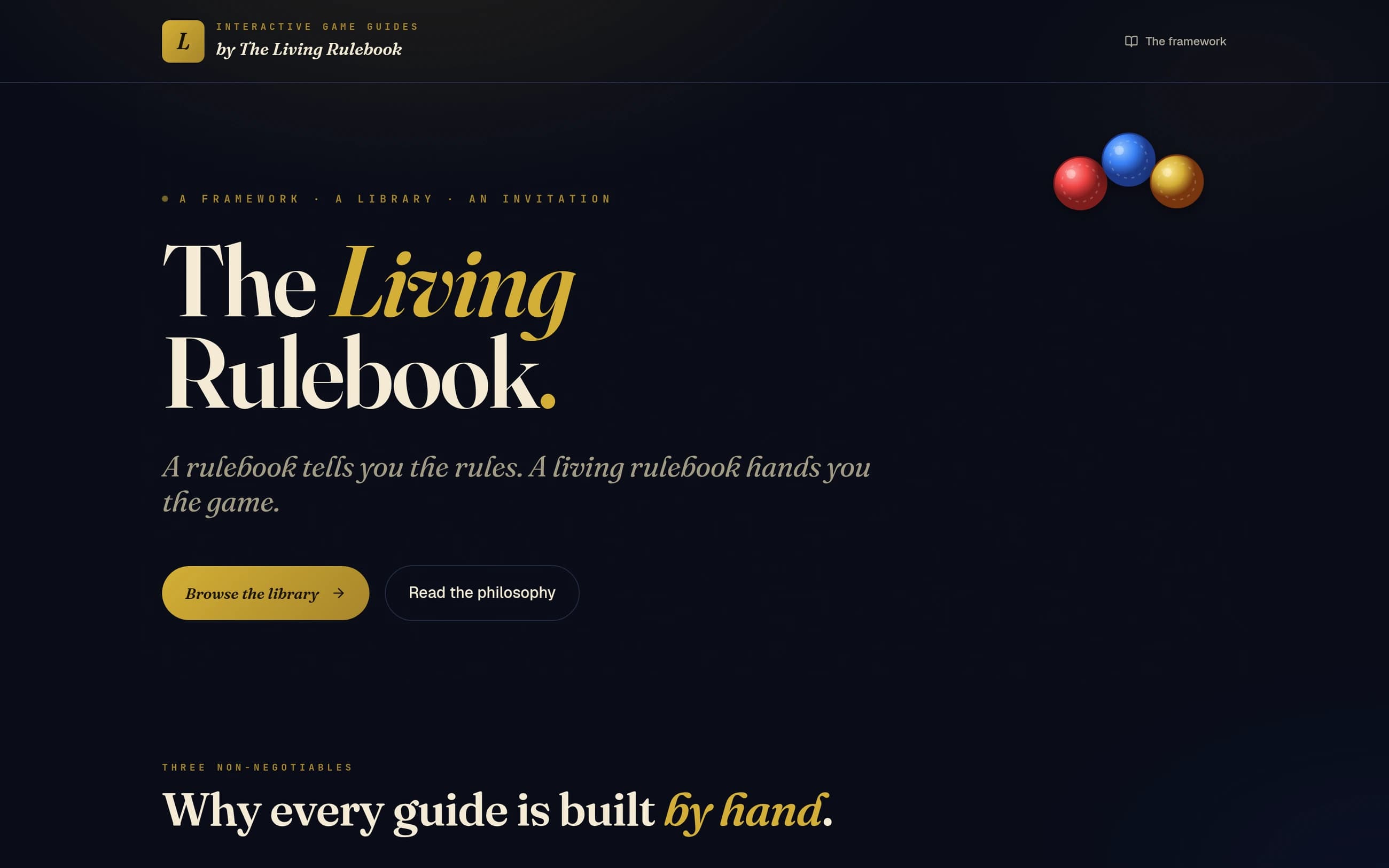
A rulebook tells you the rules. A living rulebook hands you the game.
Board-game rules ship as static PDFs. The worst moment of any game night is the twenty minutes of someone reading the manual aloud — half the table tuning out before the first turn.
The Job-to-be-Done
When I sit down to play a board game I don't know,
I want to let the rules teach themselves interactively,
So I can start playing in minutes instead of reading a manual aloud.
The Approach
I treated the rulebook as software, not a document. A game's rules are a state machine wearing a manual's clothes — so I built one framework that turns any set of rules into a guided, playable experience, then proved it across seven existing games.
The harder decision was making the platform generative rather than bespoke. Adding a game had to be cheap, or the catalog would never grow. So the framework carries ten aesthetic archetypes and a fixed ten-chapter architecture per guide: enough structure to onboard a new game fast, enough room for each to feel like its own product.
To show the framework could do more than explain other people's games, I built one of my own on it — Tarts & Traitors, a game of puddings and paranoia. New IP, shipped through the same pipeline, is the real test of whether the platform earns its keep.
The System
At the core is a reusable interactive-guide framework with a typed guide registry as the single source of truth: adding a guide is one registry entry, lazy-loaded as its own chunk. It runs on pnpm workspaces with Vite 5, React 18 and strict TypeScript, with the framework and guide packages resolved straight to source via workspace aliases. Each guide is strictly isolated — it owns its design tokens, primitives and scoped CSS animations — so one guide's styling never leaks into another.
AI opponents sit behind a swappable "AI Brain" abstraction. A zero-dependency localBrain heuristic ships as the default; a single app-level install upgrades every guide's opponents at once, each carrying a role-play personality. The landings render three.js WebGL fragment shaders with honest progressive fallbacks — no-WebGL drops to a CSS gradient, reduced-motion freezes the frame — alongside a three.js box-fold assembly animation. Production tooling lives in the routes themselves: deterministic 1920×1080 keyframe boards for AI video, and print-ready 300dpi card sheets. The whole thing builds to a static SPA, deployable to Netlify, Vercel or Cloudflare Pages.
Status
Feature-complete. The framework, seven interactive guides and the original game are built; the public catalog is launching soon, so there is nothing to claim about traffic or players yet.